"So I think what happens is it's all bravado, because you think it feels good to fight with the biggest client in the world, but eventually your businesses are going to say you've got to stop this and go make a deal with America."

If the oil infrastructure is attacked by the United States, the whole area could be flooded with oil, spilling into the Persian Gulf.

Lavrov, who addressed the UN General Assembly shortly before External Affairs Minister S Jaishankar's speech at the high-level General Debate, said India and Russia share a "particularly privileged strategic partnership".

After the US Supreme Court struck down President Donald Trump's global tariffs, Congress leader Rahul Gandhi accused Prime Minister Narendra Modi of being "compromised", saying his "betrayal" in the India-US interim trade deal stood exposed.
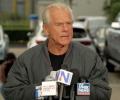
Ahead of trade talks between Indian and United States officials in Delhi, White House trade advisor Peter Navarro said India, which has the 'highest tariffs' of any major country, is 'coming to the table'.
India offset the decline in exports to traditional destinations by sharply ramping up shipments to Jordan (18,086 per cent), Hong Kong (17,006 per cent), Spain (13,436 per cent), the Philippines (2,235 per cent), and Namibia (1,068 per cent) in H1FY26.
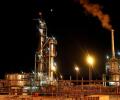
Ukrainian drones attacked the Kirishi oil refinery in Russia's northwest, one of the country's largest, sparking a fire when debris fell from a shot-down drone, Russian officials said on Sunday, France 24 reported.

'Based on the joint statement, a formal agreement will be drafted, which may take a month or month-and-a-half to finalise. We aim to sign the formal agreement by mid-March.'

Fight on toward goals that keep receding, or exit with most objectives unmet. Trump is agitated, his poll numbers falling below the Plimsoll line, his base fractured between those who back the war and those who remember that he campaigned on ending them.
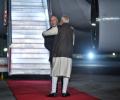
Russian President Vladimir Putin arrived in New Delhi for a two-day visit focused on strengthening ties with India, including defense cooperation and trade, amidst a changing geopolitical landscape.

India has rejected White House Trade advisor Peter Navarro's comments on New Delhi for its procurement of Russian crude oil, calling them 'inaccurate and misleading'. The relations between New Delhi and Washington are on a downturn after President Donald Trump doubled tariffs on Indian goods.

Travel disruptions following airspace closures in the Gulf have forced Daniil Medvedev and Andrey Rublev to miss an Indian Wells exhibition, while an ATP Challenger in Fujairah was cancelled amid security concerns.

Israel and the United States had a plan. Iran punched back. And now the Gulf is reeling, the world is beginning to feel the pain and, as on date, no one in Washington or Tel Aviv appears willing to admit that the punch has landed, notes Prem Panicker, continuing his must-read blog on the war in the Middle East.
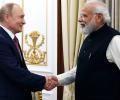
The US House Foreign Affairs Committee Democrats stated that imposing tariffs on India will not deter Russian President Vladimir Putin or address Russia's invasion of Ukraine.
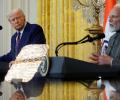
The Trump administration has told the US Supreme Court that it imposed tariffs against India for purchasing Russian energy products as part of its strategy to address the war in Ukraine.

Russian President Vladimir Putin will make a two-day visit to India from December 4 to hold annual summit talks with Prime Minister Narendra Modi that is expected to produce a plethora of significant outcomes, including in the defence sphere, to further solidify the bilateral strategic ties.
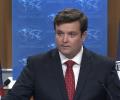
The US State Department has expressed concerns over India's trade imbalance with Washington and its purchase of Russian oil, emphasizing that President Trump has been clear with New Delhi on these issues.

External Affairs Minister S Jaishankar and US Secretary of State Marco Rubio discussed cooperation in trade, critical minerals, nuclear energy, and defence, reaffirming commitment to a free and open Indo-Pacific.

US President Donald Trump announced a new global levy on imported items, resulting in a lower tariff rate for India, following a Supreme Court verdict against his previous sweeping tariffs.
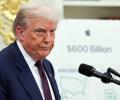
United States President Donald Trump has said India is 'very close' to China in terms of its purchases of Russian oil and will pay tariffs of 50 per cent as he indicated that 'you are going to see so much secondary sanctions'.
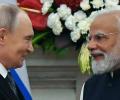
United States representative Sydney Kamlager-Dove while talking about the famous car selfie of Prime Minister Narendra Modi with Russian President Vladimir Putin said that it spoke a thousand words.

India's unabated tryst with Russian crude oil is slowly coming to an end. The time has come for Indian refiners to navigate, creatively, the choppy waters of the post-honeymoon period, and for Indian policymakers to take cognisance of the broader impact on India from the spillover of the Russian crisis - after Washington's warning to transgressors last week. Shipments from Russia to India have averaged over 1.8 million barrels a day since February, according to data from Paris-based market analytics firm Kpler. But much of the crude shipped to India was non-sanctioned because it traded below a price cap set by the US led G-7 nations in December.
Indian officials will visit the US to finalise the legal text for an interim trade agreement, expected to be signed in March, focusing on duty concessions and reciprocal tariffs.

'A deal will only be possible if India stops buying Russian oil -- but even then, New Delhi must not compromise its core red lines.'

Speaking during a meeting with top US oil and gas executives, Trump added that he was "very disappointed" the conflict had not yet ended.
Prime Minister Narendra Modi spoke with Russian President Vladimir Putin, discussing the Ukraine conflict and reaffirming the commitment to deepen the India-Russia strategic partnership. The conversation occurred amid US pressure on India over Russian oil purchases.
India and the US have entered a new phase in their relationship, marked by greater parity, point out Harsh V Pant and Vivek Mishra.

Indian envoy Vinay Mohan Kwatra discussed fair, balanced and mutually beneficial trade ties with US lawmakers amid ongoing tariff tensions between New Delhi and Washington.

Specifically, military experts are assessing if the 'Octopus' interceptor anti-drone system, produced in the UK to support Ukraine in countering Russian threats, could be repurposed to strengthen British protections against Iran's Shahed drones.
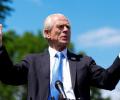
'Everybody in America loses because of what India is doing.'
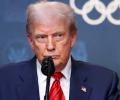
When asked about Putin and North Korean leader Kim Jong Un with Chinese President Xi Jinping at China's military parade and whether he is considering slapping secondary sanctions on Moscow, Trump said, "Well, I've already done that with regard to India, and we're doing it with regard to other things."

The pause gives the US time to breathe, to regroup, to move its expeditionary force into position without risk of interception along the way. It gives Iran nothing -- on the ground, attacks against its infrastructure continue apace. Prem Panicker in his must read daily blog on the Gulf War.

After the war erupted between Russia and Ukraine, the US and Western nations imposed sanctions on Moscow. However, India has continued to purchase Russian oil.
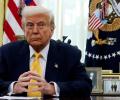
Trump also said he is "very disappointed" that India would be buying "so much oil" from Russia.
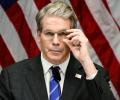
Describing the India-United States relationship as 'very complicated', US Treasury Secretary Scott Bessent on Wednesday hoped that 'at the end of the day, we will come together.'
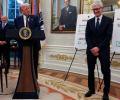
'India has intentionally taken advantage of the war in Ukraine to dramatically increase its purchases of Russian crude, when there are roughly 40 major crude providers that could satisfy Indian demand.'

What we are watching is something different: A fog manufactured and maintained by the people who started the war, so that the question of why it was started never has to be answered, observes Prem Panicker in his must read blog on the war in the Middle East.
Chief Economic Advisor V Anantha Nageswaran on Thursday said he expects that a solution to the tariff issues with the US is likely to be arrived in the next eight to ten weeks.

Lutnick said that these countries have to understand that if "you want to sell to the US consumers, you've got to play ball with the President of the United States."

'The entire US ecosystem built over decades at the bases in the Gulf region, especially the UAE, costing trillions of dollars have been decimated, dealing a mortal blow to the US Central Command's war capability,' points out Ambassador M K Bhadrakumar.
